The official automobile supplier of the British Royal Family,the world-famous Jaguar was born
from the power of passion in order to offer luxury and durable products.

Jaguar’s foundations are being laid
Jaguar’s story began when two motorcycle enthusiasts, William Lyons and William Walmsley, founded the UK-based Swallow Sidecar company in 1922. The Jaguar brand name was adopted eventually as a result of the general meeting held on March 23, 1945, and Swallow Sidecar became Jaguar Cars. Company Founder William Lyons thought that the Jaguar name would be much more distinctive and would not be associated with any similar foreign brand name and thus became the naming father of the legendary Jaguar in the future.

Continuing to offer luxury cars based on performance and elegance with its powerful engines during this period, Jaguar did not have a very bright period until the 1950s. Like many other manufacturers, due to the Second World War and the government’s material shortage, especially steel, it was a rougher period. Still, Jaguar has made a name for itself by launching a series of successful eye-catching sports cars such as Jaguar XK120 (1948-54), Jaguar XK140 (1954-57), Jaguar XK150 (1957-61) and Jaguar E-Type (1961-75), which all embody the “value for money” mentality of Lyons. The brand’s sports cars excelled in international races, and winnings from these races became a way of proving the engineering integrity of the company’s products in the 1950s. Two of the proudest moments in Jaguar’s long history in motorsport were winning the Le Mans 24-hour race, the first in 1951 and the second in 1953. The 1955 Le Mans victory was overshadowed by the worst motorsport crash in history. It then added two more wins to the Jaguar household in 1956 and 1957 at the hands of Scottish racing team Ecurie Ecosse.

In 1950 Jaguar agreed to lease two of the Ministry of Supply’s factories in Browns Lane, Allesley, Coventry, which were then used by the Daimler company, and within the next twelve months it moved from Foleshill to the new facility. Jaguar bought Daimler from BSA in 1960. From the late 1960s, Jaguar continued to take its place in the most luxurious galleries with the Daimler brand.

End of independence…
Pressed Steel company produced all the monocoque bodies for Jaguar. It left the supply and assembly of the mechanical parts to Jaguar while only providing them. In mid-1965, British Motor Corporation (BMC), an Austin-Morris merger, purchased Pressed Steel. Co-Founder William Lyons began to worry about Jaguar’s future, partly due to the threat to his continued body supply and partly because of his age and lack of heirs. It therefore accepted BMC’s offer to merge with Jaguar to form the British Motor holding. At a press conference held at the Great Eastern Hotel in London on 11 July 1965, Lyons and BMC chairman George Harriman announced that the Jaguar Group of Companies would merge with British Motor Corporation as the first step towards forming a joint holding company that would be called British Motor Holdings. Over time, BMC changed its name to British Motor Holdings at the end of 1966. As a result, a new holding company, the British Leyland Motor Corporation, emerged in 1968, but this combination did not succeed. Bad decisions by the Board of Directors contributed to this failure, as well as the Austin-Morris division’s reflection of financial difficulties in the Ryder Report, which effectively led to its nationalization in 1975.

Temporary return to independence
Over the next few years, it became clear that due to low regard for many of the group’s products, sufficient capital would not be available to develop and start production of new models, including Jaguars, especially if Jaguar remained a part of the group. In July 1984, Jaguar was listed as a separate company. This was one of the many privatizations of the Thatcher government, and Jaguar built its own track record. Sir John Egan, who was appointed President in 1980, made his mark in the history of the brand as the name that provided the unprecedented prosperity of Jaguar immediately after its privatization. In early 1986, Egan reported that Jaguar had resolved key problems that prevented it from selling more cars, such as quality control, delayed delivery schedules, and poor productivity. It laid off a third of the company’s nearly 10,000 employees to cut costs. Sir John Egan also intensified his efforts to improve the quality of Jaguar. Price increases in the United States were masked by the favorable exchange rate.

The Ford Motor Company era
Jaguar was delisted on the London Stock Exchange on 28 February 1990. In 1999, it became part of Ford’s new Premier Automotive Group, along with Aston Martin, Volvo Cars and from 2000 Land Rover. While the Ford-owned Jaguar never made a profit, it expanded its product range with the introduction of the S-Type in 1999 and the X-type in 2001. The brand became closely associated with Jaguar after PAG bought the Land Rover, acquired by Ford in May 2000. They shared a common sales and distribution network in many countries, including joint dealerships, and some models shared common components. On June 11, 2007, Ford announced plans to sell Jaguar along with Land Rover, and hired the services of Goldman Sachs, Morgan Stanley and HSBC to advise on the deal. The sale was originally expected to be announced in September 2007, but was delayed until March 2008.

The Tata Motors era
Ford announced on March 26, 2008 that it had agreed to sell its Jaguar and Land Rover operations to Tata Motors of India, and that they expected to complete the sale by the end of the second quarter of 2008. The deal included the rights to three other British brands, Jaguar’s own Daimler, and two dormant brands Lanchester and Rover. On June 2, 2008, the sale to Tata was completed for £1.7 billion. Tata Motors, part of the Tata Group, established Jaguar Land Rover Limited on January 18, 2008 as a British-registered and wholly-owned subsidiary. The company was to be used as a holding company for the acquisition of two businesses, Jaguar Cars Limited and Land Rover, from Ford. This acquisition was completed on June 2, 2008. On January 1, 2013, operating as two separate companies, Jaguar Cars Limited and Land Rover, the group underwent a fundamental restructuring. The parent company was renamed Jaguar Land Rover Automotive PLC, Jaguar Cars Limited was renamed Jaguar Land Rover Limited, and Land Rover’s assets were transferred to it. As a result, Jaguar Land Rover Limited became responsible for the design, manufacture and marketing of both Jaguar and Land Rover products in the UK.

Jaguar factories from the beginning to the present…
The Swallow Sidecar company was based in Blackpool in 1922. When demand for Austin Swallow exceeded the factory’s capacity, the company moved to Holbrook Lane in Coventry in 1928. In 1951 the company moved beyond the original Coventry site to Browns Lane, a wartime “shadow factory” operated by Daimler. The Browns Lane factory ceased its last operations in 2005. The Browns Lane factory, which continued to produce coatings for a while and hosted the Jaguar Daimler Heritage center until it was moved to the British Motor Museum site, is being rebuilt today despite being demolished. Jaguar bought the Whitley engineering center from Peugeot in 1986. In 2016, Jaguar also moved to part of the former Peugeot/Chrysler/Rootes facility in Ryton-on-Dunsmore, which closed ten years ago. This is now home to Jaguar Land Rover’s classic restoration operation.

Jaguar Eyewear
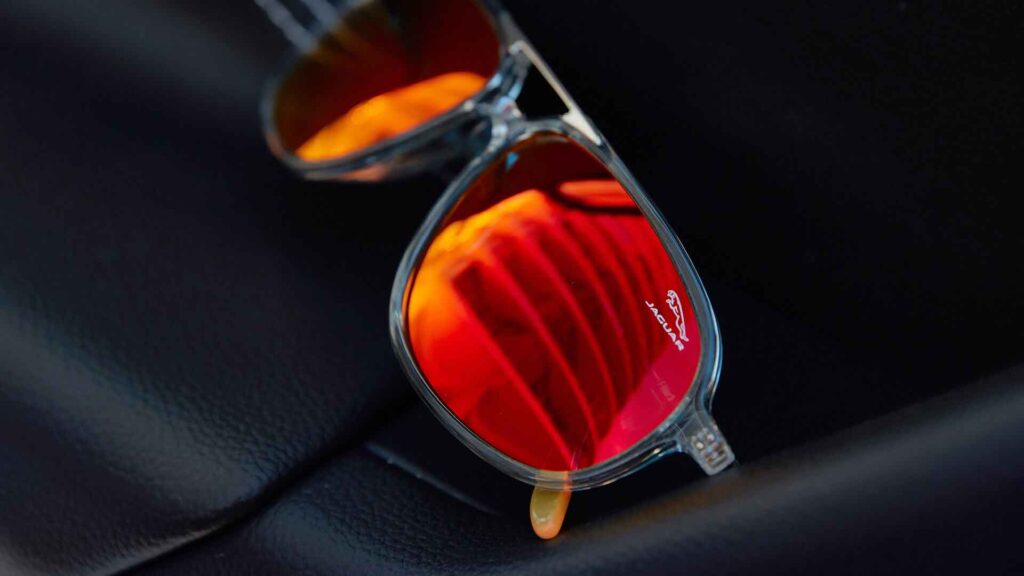
Jaguar continues to deliver at the highest level one can expect from a British brand. The official supplier of the royal family since 1951, Jaguar never compromises on luxury, nobility and high quality. No other automaker has been allowed to display all three “Royal Warrants” at the same time. That is why the Jaguar eyewear collections, still offered today within the Menrad Group, combine the latest innovations in eyewear technology with unique design transfers to create modern and sporty optical frames and sunglasses. Details and materials you can find inside a car, sophisticated color effects and glass shapes reminiscent of the lines of a car make Jaguar’s eyewear unique and sought after.

The spirit of performance
One of the most striking segments among Jaguar eyewear collections is the brand’s breakthrough performance eyewear. Eyeglasses in the performance segment impress users with their dynamic profiles and innovative designs. The Jaguar eyewear design team said that comfort comes first and that the combination of lightness and ideal fit is of great importance. Jaguar prefers to use materials like Ultem, which make the brand’s frames flexible, dimensionally stable, and up to forty-five percent lighter than traditional acetate eyeglasses. Jaguar, which is literally a lifestyle, has a strong passion for motors and reflects this passion built into its history with its glasses. This is why the Spirit Line underlines the Jaguar lifestyle, while the models in the collection stand for clear, sporty design, extraordinarily balanced proportions and sophisticated details. Inspired by the colors of Jaguar cars, modern color accents are carefully used inside and outside the lenses.

Deep-rooted British heritage turns into glasses
The Jaguar Heritage segment pays homage to legendary historic vehicles that combine cutting-edge technology with exceptional beauty and impressive performance. Thanks to the modern handling of designs, retro-inspired luxury frames continue to be the choice of those who do not compromise on their style, as they are extremely visually appealing. Jaguar’s Classic segment is presented as a modern interpretation of timeless classics. These models are versatile smart products for elegant and sporty gentlemen, with elegant colours, balanced glass shapes and the highest quality craftsmanship. The special design transfers crafted onto the models in the Classic segment form an elegant yet strong connection with the Jaguar brand. Jaguar’s Ultimate segment promises the highest value frames. These models, which use premium materials such as pure titanium or gold plating, thus occupy an incredibly privileged place. Classic design and excellent craftsmanship make this segment attractive for men looking for the best eyewear.


January 2023